Loading...

Over the past decade, UK summers have changed. Heatwaves that were once rare are now an annual fixture, and a bus service that cannot keep its cabin cool is no longer a minor comfort complaint — it is an operational and reputational problem. Double-decker operators, in particular, face a unique set of air-conditioning issues, because one vehicle carries two decks of passengers, limited roof space and a bridge-conscious height envelope.
This article walks through the four problems UK double-decker fleets raise most often, and explains how a purpose-built built-in (concealed) bus air conditioning unit — such as the TCHAIN TC45N2 for 12–13 m double-deckers — addresses them.
1. Problem: the upper deck becomes a heatbox
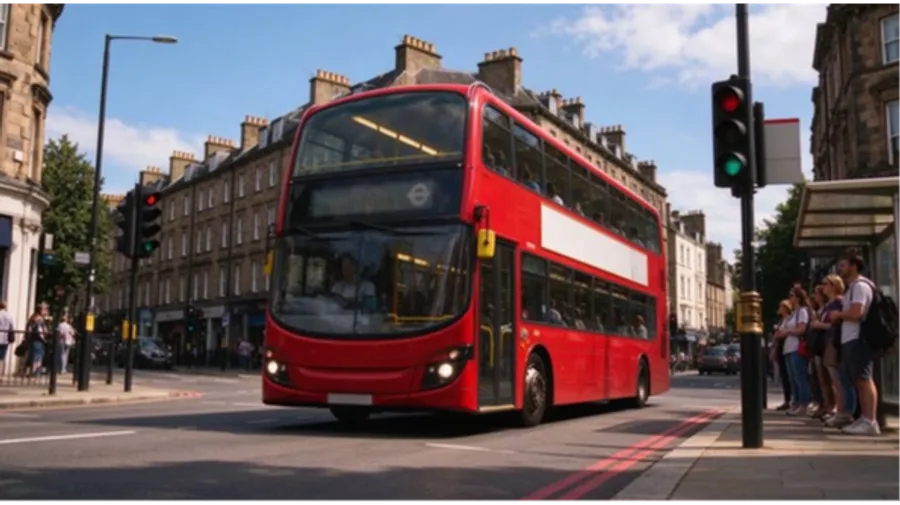
Heat rises. On a 32 °C afternoon, the upper deck of a double-decker — closest to the glass roof and furthest from the cool air supply — can feel several degrees hotter than the lower saloon. Passengers crowd downstairs, leave the bus, or complain to the operator and the local authority.
The root causes are usually a combination of undersized cooling capacity, poorly balanced ducting between decks, and evaporator fans that simply cannot move enough air.
The solution: size the cooling capacity for the worst deck, not the average cabin. A built-in evaporator that delivers around 9,600 m³/h of airflow, paired with a 45,000 kcal/h condenser, is engineered to hold both decks comfortably through a hot UK afternoon. Balanced ducting feeds cool air to the upper saloon first — the part of the bus that needs it most.
2. Problem: the roof is already full (and the bridges are low)
A typical UK double-decker already carries destination displays, ventilation hatches, antennas and emergency exits on its roof. Strapping another bulky rooftop package on top is rarely a clean install — and every extra centimetre of roof height matters on a network famous for low railway bridges.
The solution: choose a built-in, concealed architecture. Instead of one large rooftop pod, the system splits into a condenser and an evaporator installed inside or beneath the vehicle body, keeping the external roof profile low and leaving mounting space for the displays and equipment operators actually need.
3. Problem: ageing fleets need a replacement that just fits
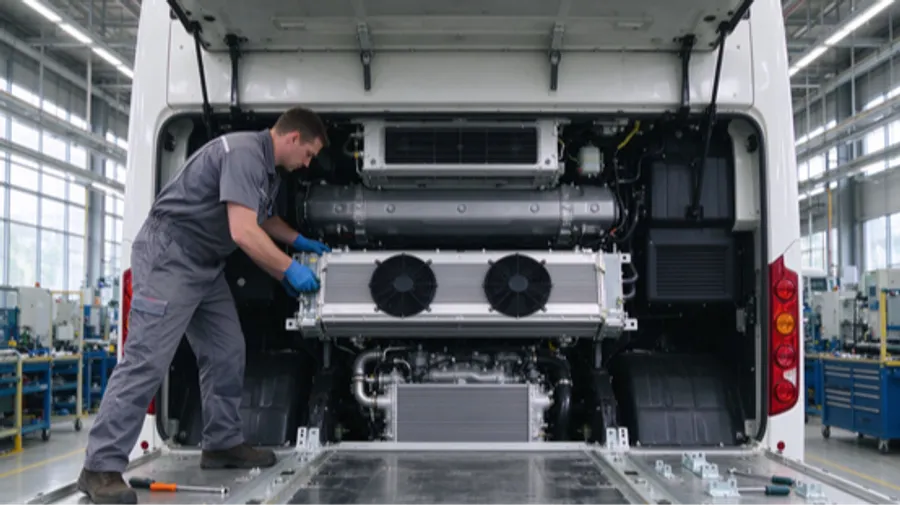
Many UK double-deckers now in service were specified years ago, and their original air conditioning has degraded — weak cooling, noisy fans, leaky joints, compressor trips. Operators do not want to replace the whole vehicle; they want a drop-in replacement that works with the standard 24 V electrical architecture already on the bus.
The solution: look for a replacement unit designed around DC 24 V vehicle power, using R134a refrigerant and a rated current that a standard bus electrical system can support — the TC45N2 runs at ≤130 A. Split built-in units are also easier to manoeuvre into an existing engine compartment than a single one-piece rooftop pod, which means shorter garage time and fewer vehicles off the road.
4. Problem: cooling output versus weight (and running cost)
Every kilogram added to a bus is paid back in fuel (or in battery range, on electric routes). A heavy over-specified unit cripples operating costs; a light under-specified unit fails to keep passengers cool. The engineering answer is not "a bigger unit", but the right-sized unit.
The solution: a built-in system around 300 kg — such as the TC45N2 at ≤300 kg for a 12–13 m double-decker — is the deliberate balance point: enough condenser face area and fan capacity for two decks, without carrying unnecessary mass.
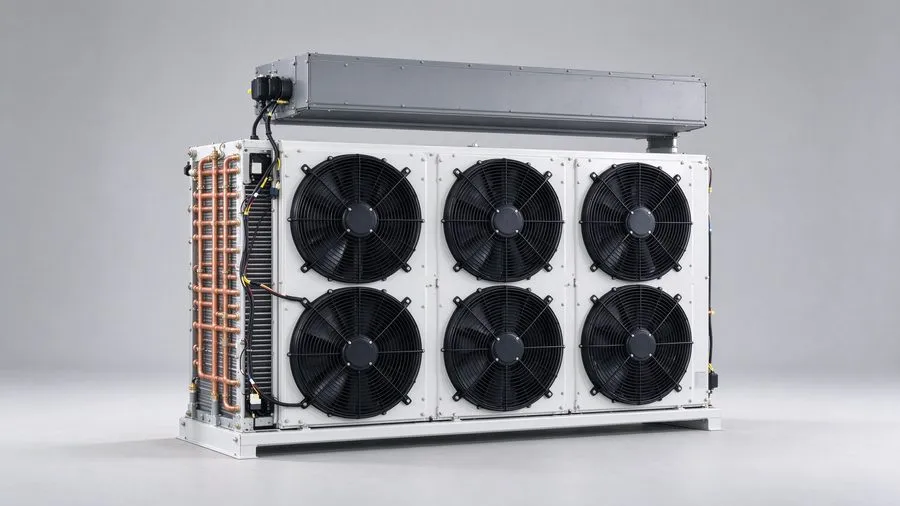
The unit: TCHAIN TC45N2 built-in air conditioner for 12–13 m double-deckers
- Cooling capacity: 45,000 kcal/h
- Rated current: ≤130 A (DC 24 V)
- Airflow: 9,600 m³/h
- Refrigerant: R134a
- Application: 12.0–13.0 m double-decker buses (overseas market)
- Dimensions: L 2034 × W 740 × H 1161 mm
- Weight: ≤300 kg
FAQs: built-in air conditioning for UK double-deckers
Q: What voltage does a UK double-decker bus air conditioner run on?
A: Most conventional and hybrid double-deckers on UK fleets use a DC 24 V vehicle electrical system. A replacement built-in unit should be specified for 24 V (like the TC45N2) rather than a 12 V unit, which cannot deliver the cooling output two decks need.
Q: Can built-in air conditioning be retrofitted to an existing double-decker?
A: Yes — that is one of the main reasons operators choose concealed split systems. The condenser and evaporator are fitted separately into the engine compartment and saloon ducting, which is usually easier than lifting a one-piece rooftop unit. Installation detail depends on the specific bus model; send us your vehicle specification for a fitment review.
Q: What cooling capacity do I need for a double-decker bus?
A: For a 12–13 m double-decker operating in a hot climate, plan for roughly 40,000–45,000 kcal/h of cooling and around 9,000–10,000 m³/h of airflow. Undersizing is the single most common reason passengers complain on hot days.
Q: Which refrigerant does this unit use?
A: The TC45N2 uses R134a, the established charge for this class of built-in bus air conditioning. Refrigerant and homologation requirements vary by project and market — ask us about the configuration that suits your fleet.