Loading...

For electric buses and other heavy-duty electric vehicles, battery performance depends not only on charging and driving strategies but also on maintaining suitable operating temperatures.
Battery Thermal Management Systems (BTMS) are designed to control battery temperature and temperature differences between cells. By cooling or heating the battery when required, these systems can support battery durability, safety, range and consistent performance during intensive commercial operation.
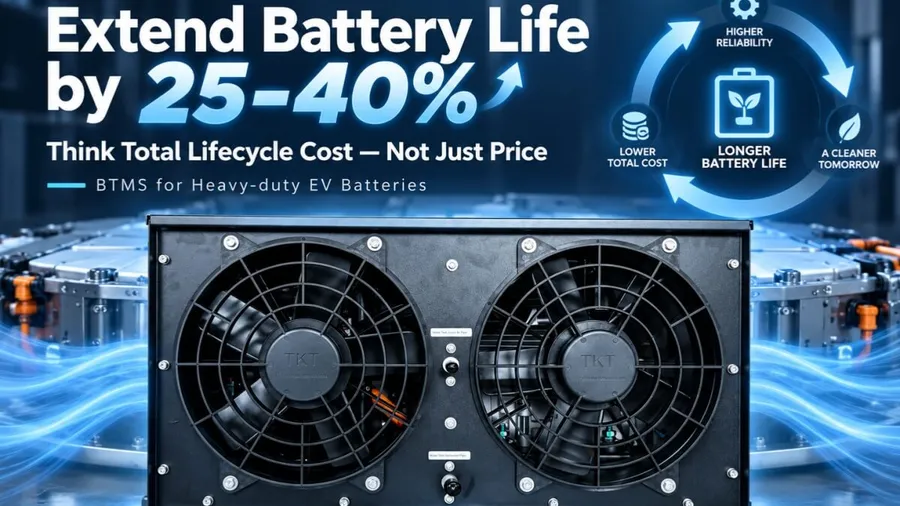
Electric buses and other heavy-duty EVs operate under demanding conditions. Frequent charging, high power demand, long operating hours, changing loads and varying ambient temperatures can expose battery packs to significant thermal stress.
Charging strategies, driving behaviour and routine maintenance can help limit degradation, but they cannot directly control the temperature at which the battery operates. This is where BTMS becomes particularly important.
For high-utilisation commercial vehicles, maintaining suitable and relatively uniform cell temperatures can contribute to more stable battery performance over the vehicle lifecycle.
 📷
📷Battery management also depends on how the vehicle is operated. Common approaches include avoiding prolonged exposure to very high or very low states of charge, limiting unnecessary high-power charging, reducing extreme current peaks and carrying out regular battery inspections.
Environmental conditions also matter. Very high temperatures can increase battery stress, while charging at very low temperatures can create additional degradation risks.
These measures help reduce battery stress, but increasingly large battery packs, faster charging and intensive daily operation make active thermal management an important part of heavy-duty EV design.
Lithium-ion batteries are sensitive to both excessive heat and low temperatures.
High temperatures can accelerate ageing mechanisms within the cells, while low-temperature charging can increase internal resistance and create additional electrochemical stress.
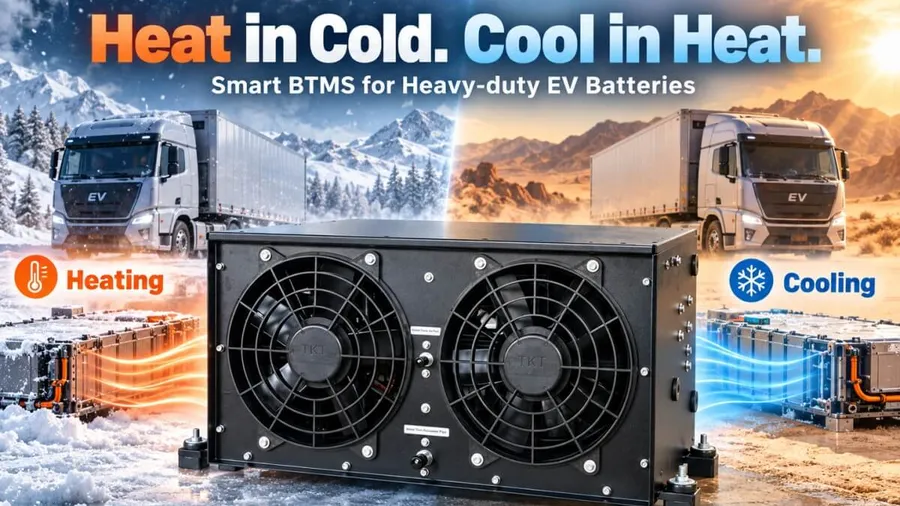
BTMS therefore does more than simply cool the battery. Depending on operating conditions, it can:
cool the battery during high-load operation or fast charging;
heat the battery in low-temperature environments;
reduce temperature differences between individual cells;
respond dynamically to information from the Battery Management System (BMS);
support battery protection during abnormal thermal conditions.
Temperature uniformity is particularly important in large battery packs. If some cells consistently operate at higher temperatures than others, they may age faster and eventually limit the performance of the complete pack.
For more details, please read the original article: https://www.busthermo.com/how-to-extend-ev-battery-lifespan/
BTMS architectures can broadly be divided into passive and active approaches.
Passive systems use technologies such as phase-change materials or heat pipes to absorb or transfer heat with limited additional energy consumption. Their relatively simple architecture can be useful under moderate thermal loads or as a complementary solution.
Active systems use components such as fans, pumps, heat exchangers and refrigeration circuits to actively cool or heat the battery. They offer greater control and are better suited to applications involving high charging power, demanding duty cycles and extreme ambient temperatures.
Within active thermal management systems, liquid cooling is particularly suitable for large commercial-vehicle battery packs.
Compared with air cooling, a liquid circuit can provide greater heat-transfer capability and more precise temperature control during sustained high-power charging and operation.
A typical liquid-cooled system can combine a water-glycol coolant circuit, cooling plates, a chiller and an electric heater. Together, these components can provide cooling, heating and temperature equalisation through the same thermal-management architecture.
This makes liquid cooling particularly relevant for electric buses and other heavy-duty vehicles operating for long hours or using high-power charging.
When battery cells generate heat, that heat is transferred through the battery structure to cooling plates. Coolant circulating through these plates carries the heat away from the battery pack.
The heated coolant can then exchange heat with the vehicle's refrigeration circuit through a chiller before returning to the battery.
In cold conditions, the same circuit can be used to warm the battery before charging or high-power operation.
The system can operate in different modes depending on battery temperature, vehicle operation and commands from the BMS.
Battery thermal management is becoming increasingly important as commercial electric vehicles adopt larger batteries, faster charging and more intensive operating cycles.
For electric buses, an effective BTMS can help maintain suitable battery temperatures, reduce thermal differences between cells and support stable performance throughout the vehicle's operating life.
Future systems are expected to continue evolving toward greater integration, heat-pump-based architectures, more precise temperature control and predictive thermal-management strategies.